
 7 Courses
- Oct 21, 2026
- Nov 4, 2026
- Nov 18, 2026
- Dec 2, 2026
- Dec 16, 2026
- Dec 30, 2026
- Jan 13, 2027
Interviewing is one of the most challenging aspects of management, yet many leaders never receive formal training in this critical skill. Without proper guidance, we make hiring decisions based on gut feelings and casual conversations, lacking clear direction on what to look for, what questions to ask, or how to evaluate responses. The good news? There are proven, evidence-based approaches that can transform your interviewing effectiveness.
In this course, Professor JR Keller draws on extensive research and real-world examples to provide a clear, three-step process for conducting interviews that enable candidates to shine while delivering reliable hiring decisions. Through practical frameworks and tools, you will design structured questions that predict job performance, create consistent evaluation methods, and implement proven interviewing techniques. The course demonstrates how to apply these principles to both in-person and remote hiring scenarios while minimizing the cognitive biases that often interfere with good decision making.
Whether you're an experienced hiring manager or new to interviewing, this course equips you with concrete skills to make better hiring decisions while creating positive experiences for candidates. You will develop efficient systems for managing multiple interviews, setting candidates at ease and evaluating responses objectively. By the end of the course, you'll be prepared to transform your hiring process from conversation based to competency focused, leading to better hires and stronger teams.
- Nov 4, 2026
- Nov 18, 2026
- Dec 2, 2026
- Dec 16, 2026
- Dec 30, 2026
- Jan 13, 2027
- Jan 27, 2027
The conversation around employee pay has changed over the years from one of base salaries, bonuses, and cash compensation, to a “total rewards” approach that seeks the right blend of monetary and non-monetary elements that will engage each employee while generating valuable business results.
Cornell University ILR School faculty Linda Barrington and Diane Burton are the thought leaders behind Cornell's prestigious Institute for Compensation Studies. This team of authors offers a learning experience that applies evidence-based, social science approaches to the field of compensation. This course will equip you with the tools and insights needed to apply a “total rewards” view to compensation that aligns with your organization's strategic goals and operational realities.
- Nov 4, 2026
- Nov 18, 2026
- Dec 2, 2026
- Dec 16, 2026
- Dec 30, 2026
- Jan 13, 2027
- Jan 27, 2027
In today's competitive job market, retaining top talent is more challenging than ever. High employee turnover not only disrupts team dynamics but also demands significant time and resources. A well-designed onboarding process, however, can reduce turnover, accelerate time to productivity, and strengthen long-term employee retention.
Onboarding presents a strategic opportunity to align the early experiences of new hires with your organizational goals. A strong onboarding plan does more than teach employees how to perform their roles — it also fosters a sense of belonging, builds connections, and sets clear, measurable objectives that support both individual and organizational success.
Drawing on extensive research, Professor JR Keller provides a science-based, practical approach to designing an effective onboarding experience. You will begin by exploring the four major domains of onboarding and their impact on employee engagement, job satisfaction, and organizational fit. From there, you will discover how to map specific tasks to milestones, build a structured plan that involves both new hires and their colleagues, and identify metrics to evaluate your plan's effectiveness. You will also explore emerging technologies that can support and enhance onboarding delivery.
This course will equip you with the tools to transform onboarding from a routine checklist into a purposeful, results-driven program. By the end of the course, you'll be able to create a measurable onboarding plan that fosters early engagement, supports long-term success, and contributes to a positive and productive workplace culture.
- Oct 21, 2026
- Nov 18, 2026
- Dec 16, 2026
- Jan 13, 2027
- Feb 10, 2027
- Mar 10, 2027
- Apr 7, 2027
Candidate evaluation is the second stage of the hiring process. The evaluation stage allows your organization to determine which candidates from your diverse talent pool are the most qualified to meet the needs of an open position. During candidate evaluation, every step, from reviewing résumés to conducting interviews and making selection decisions, offers an opportunity for inclusion. Yet each step within this stage of the hiring process also has pitfalls that can result in candidates of marginalized identities being excluded and impacting your organization's long-term inclusion goals.
In this course, you will begin by examining how the candidate evaluation stage fits within an inclusive hiring approach, including the power of decision making in candidate selection. You will explore best practices for early-stage candidate evaluations and for interviewing candidates, and you'll evaluate the potential challenges of common approaches like pre-interview assessments and interviewing for “fit.” You can use these best practices to make inclusive selection decisions that reduce bias and emphasize equity in candidate selection.
You are required to have completed the following courses or have equivalent experience before taking this course:
- Building Diverse Talent Pools
- Nov 4, 2026
- Jan 27, 2027
- Apr 21, 2027
- Jul 14, 2027
- Oct 6, 2027
- Dec 29, 2027
Artificial intelligence is rapidly transforming talent acquisition, reshaping how organizations attract, evaluate, and engage candidates. From automating job description creation to enabling large-scale candidate assessment, AI introduces new efficiencies while also raising important questions about bias, transparency, and the role of human judgment. As adoption grows, organizations must balance innovation with ethical considerations and a strong focus on candidate experience.
In this course, you will explore how AI is applied across the talent acquisition life cycle, including job design, candidate evaluation, and hiring at scale. You'll examine practical use cases ranging from basic tools to more advanced AI-driven approaches, and you'll identify the data, skills, and context needed to use them effectively. You'll also assess your organization's current talent acquisition challenges, evaluate where AI can add value, and analyze risks such as bias, privacy, and overreliance on automation. You'll consider stakeholder perspectives, human-in-the-loop decision making, and the impact of AI on the candidate experience and organizational outcomes.
Upon completion of this course, you will be able to identify where AI can improve talent acquisition processes while recognizing its limitations and risks. You'll be prepared to evaluate AI tools for job design and candidate assessment, ensure appropriate human oversight, and make informed decisions about implementation. You'll also be equipped to assess vendor solutions, measure potential ROI, and shape a talent acquisition strategy that balances efficiency, fairness, and a positive candidate experience.
You are required to have completed the following course or have equivalent experience before taking this course:
- Understanding AI Technologies in Human Resources
- Dec 2, 2026
- Jan 27, 2027
- Mar 24, 2027
- May 19, 2027
- Jul 14, 2027
- Sep 8, 2027
- Nov 3, 2027
Symposium sessions feature two days of live, highly interactive virtual Zoom sessions that will explore today's most pressing topics. The AI Symposium offers you a unique opportunity to engage in real-time conversations with peers and experts from the Cornell community and beyond. Using the context of your own experiences, you will take part in reflections and small-group discussions to build on the skills and knowledge you have gained from your courses.
Join us for the next Symposium, in which we'll share experiences from across the industry, inspiring real-time conversations about best practices, innovation, and the future of AI. You will support your coursework by applying your knowledge and experiences to some of the most pressing topics and trends in the field. By participating in relevant and engaging discussions, you will discover a variety of perspectives and build connections with your fellow participants from across a variety of industries.
All sessions are held on Zoom.
Future dates are subject to change. You may participate in as many sessions as you wish. Attending Symposium sessions is not required to successfully complete any certificate program. Once enrolled in your courses, you will receive information about upcoming events. Accessibility accommodations will be available upon request.
Symposium sessions feature two days of live, highly interactive virtual Zoom sessions that will explore today's most pressing topics. The HR Symposium offers you a unique opportunity to engage in real-time conversations with peers and experts from the Cornell community and beyond. Using the context of your own experiences, you will take part in reflections and small-group discussions to build on the skills and knowledge you have gained from your courses.
Join us for the next Symposium, in which we'll share experiences from across the industry, inspiring real-time conversations about best practices, innovation, and the future of human resources work. You will support your coursework by applying your knowledge and experiences to some of the most pressing topics and trends in the HR field. By participating in relevant and engaging discussions, you will discover a variety of perspectives and build connections with your fellow participants from across the industry.
All sessions are held on Zoom.
Future dates are subject to change. You may participate in as many sessions as you wish. Attending Symposium sessions is not required to successfully complete any certificate program. Once enrolled in your courses, you will receive information about upcoming events. Accessibility accommodations will be available upon request.
eCornell online Workshops are live, interactive learning experiences lasting 1 to 4 hours and led by Cornell faculty experts. These premium, short-format sessions focus on AI topics and are designed for busy professionals who want to gain immediately applicable skills and strategic perspectives. Workshops may include faculty presentations, breakout discussions, and guided hands-on practice.
The AI Workshops All-Access Pass provides you with unlimited participation for 6 months from your date of purchase. Whether you choose to attend one Workshop per month or several per week, the All-Access Pass allows you to customize your AI journey and stay on top of the latest AI trends.
Hosted by Cornell faculty at the forefront of their fields, Workshops cover a range of cutting-edge AI topics applicable across industries. Workshops are offered at three levels to allow you to choose topics that match your experience.
- AI Foundations
- These Workshops introduce core AI concepts, terminology, capabilities, limitations, and practical applications. No prior AI experience is required.
- Best for: Beginners, AI-curious professionals, and teams starting their AI journey.
- AI in Practice
- These Workshops focus on practical skills, workflows, and strategies that help participants use AI more effectively in their day-to-day work. Some familiarity with AI tools is recommended.
- Best for: Professionals who have experimented with AI and want to build confidence and capability.
- AI Leadership and Transformation
- These advanced Workshops explore emerging technologies, strategic implementation, governance, organizational impact, and specialized applications. AI fluency is expected, and some Workshops may have prerequisites.
- Best for: AI leaders, transformation teams, executives, and advanced practitioners.
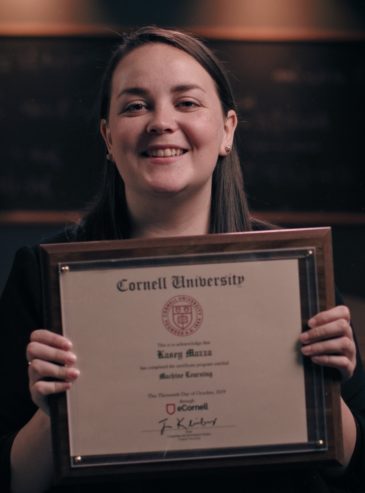



eCornell was truly one of the best investments I made in my entire career and it’s what brought me to where I am now.