

Course list

In this course, you will identify the basic elements necessary to write components that make calculations and choices for you. While each programming language has its own set of rules and varying syntax, here you will be focusing on programming with Python. The logic and skills you use to write simple Python programs are useful for developing your problem-solving abilities. Throughout this course, you will examine how to break down complex problems into smaller, more accessible components and write programs that solve them, step by step.
  • May 20, 2026
  • Aug 12, 2026
  • Nov 4, 2026
  • Jan 27, 2027
  • Apr 21, 2027

In this course, you will write programs to automate repetitive tasks within basic data sets. You will explore how to sort and order simple text using list structures within the Python programming language. By breaking down scripts and texts into smaller parts, you will discover how to accomplish larger tasks by tackling each individual piece. You will then practice automating these basic functions into fundamental building blocks that can be reused as you enhance and expand your coding vocabulary. By the end of this course, you will have built your own playable game that you can continue to iterate and improve as your programming knowledge grows.

You are required to have completed the following course or have equivalent experience before taking this course:

  • How to Write Programs That Make Choices With Control Flow
  • Jun 3, 2026
  • Aug 26, 2026
  • Nov 18, 2026
  • Feb 10, 2027
  • May 5, 2027

Databases power things that we rely on every day of our lives, from displaying restaurant menus to processing payments to tracking likes and comments. These tasks require you to work with much more data than you may be used to, as real-life data sets can be extremely large and cumbersome. Using a database to organize your data allows you to work with it systematically and at scale.

This course provides you with the foundational knowledge for integrating databases into your programs and using them to read, write, store, and process data. You will cover the basics of working with files and complex data structures. You will explore important data formats like JSON and CSV, discover how to write database queries that extract information of interest from a database, and get an introduction to the SQL database programming language. With these new tools, you will be able to work with huge amounts of data that would otherwise be tedious and time consuming to process manually.

You are required to have completed the following courses or have equivalent experience before taking this course:

  • How to Write Programs That Make Choices With Control Flow
  • How to Write Functions to Automate Repetitive Tasks
  • Jun 17, 2026
  • Sep 9, 2026
  • Dec 2, 2026
  • Feb 24, 2027
  • May 19, 2027

In this course, you will begin to work with web services and applications that allow you to complete certain tasks online. As part of your coursework, you will write a program that connects and pulls data from the web. Expanding upon this, you will then scale your data collection to get large amounts of data in the form of a database, and you will use the data you collect to create your own web service. You will be introduced to a web framework called Flask that utilizes prepackaged HTML templates to allow you to systematically set up and operate your web service, enabling others to interact with your content.

The following course is required to be completed before taking this course:

  • How to Write Programs That Work With Databases

Additionally, you are required to have completed the following courses or have equivalent experience:

  • How to Write Programs That Make Choices With Control Flow
  • How to Write Functions to Automate Repetitive Tasks
  • Jul 1, 2026
  • Sep 23, 2026
  • Dec 16, 2026
  • Mar 10, 2027
  • Jun 2, 2027

With the introduction of three more programming languages in this course, you will create interactive web applications that let users do things in their browsers, such as upload photos or play simple games. Using HTML, you can create the basic framework of a website, write CSS to decorate and style the site, and then see how JavaScript can be used to add engaging interactive elements. You will also get a chance to automate the HTML writing by using the Flask framework to more easily produce web page structures, allowing you to connect your apps to a database to generate bulk HTML content programmatically.

The following courses are required to be completed before taking this course:

  • How to Write Programs That Work With Databases
  • How to Develop Web Interfaces With Online Protocols

Additionally, you are required to have completed the following courses or have equivalent experience:

  • How to Write Programs That Make Choices With Control Flow
  • How to Write Functions to Automate Repetitive Tasks
  • Apr 22, 2026
  • Jul 15, 2026
  • Oct 7, 2026
  • Dec 30, 2026
  • Mar 24, 2027
  • Jun 16, 2027

eCornell Online Workshops are live, interactive 3-hour learning experiences led by Cornell faculty experts. These premium short-format sessions focus on AI topics and are designed for busy professionals who want to gain immediately applicable skills and strategic perspectives. Workshops include faculty presentations, breakout discussions, and guided hands-on practice.

The AI Workshops All-Access Pass provides you with unlimited participation for 6 months from your date of purchase. Whether you choose to attend one workshop per month, or several per week, the All-Access Pass will allow you to customize your AI journey and stay on top of the latest AI trends.

Workshops cover a range of cutting-edge AI topics applicable across industries, hosted by Cornell faculty at the forefront of their fields. Whether you are just getting started with AI, seeking to build your AI skillset, or exploring advanced applications of AI, Workshops will provide you with an action-oriented learning experience for immediate application in your career. Sample Workshops include:

  • Work Smarter with AI Agents: Individual and Team Effectiveness
  • Leading AI Transformation: Bigger Than You Imagine, Harder Than You Expect
  • Using AI at Work: Practical Choices and Better Results
  • Search & Discoverability in the Era of AI
  • Don't Just Prompt AI - Govern it
  • AI-Powered Product Manager
  • Leverage AI and Human Connection to Lead through Uncertainty

Request
more Info
by completing the form below.

Act today—courses are filling fast.

How It Works

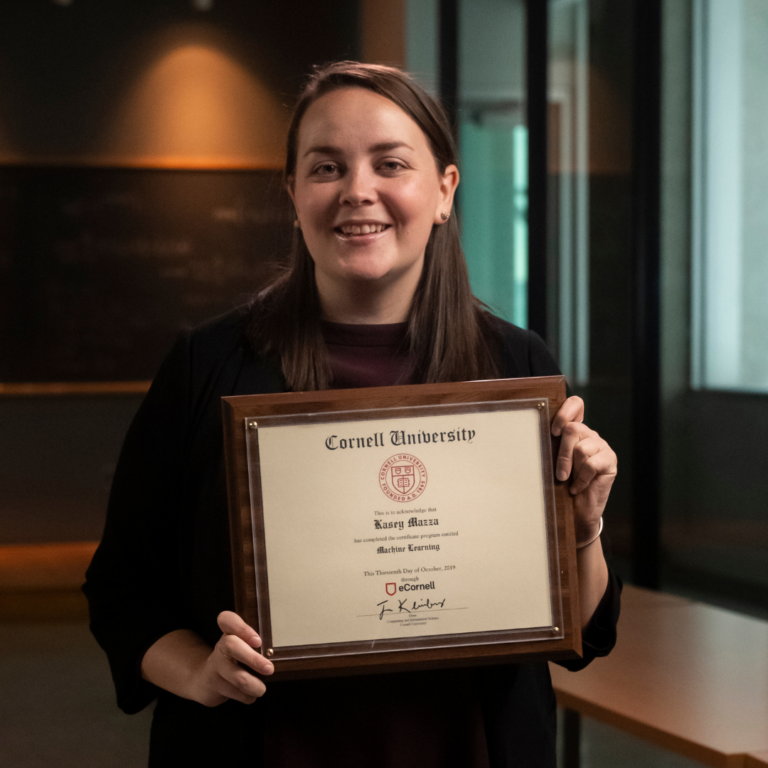
Completing a program from eCornell really has allowed me to think outside the box at work. It gave me the confidence I needed to take a seat at that table and say I am ready.
‐ Kasey M.
Kasey M.

Frequently Asked Questions

Modern work runs on web applications, and even non-developers are expected to understand how data moves from a database to an interface, how APIs work, and what it takes to ship reliable features. Building that fluency can help you collaborate more effectively with technical teams and make better product, project, and business decisions.

Authored by faculty from Cornell Tech, Cornell’s Web App Development Certificate will help you build a practical, full-stack foundation by learning how to write Python programs, work with structured data (JSON and CSV), query and organize data with SQL, connect programs to the web with HTTP and APIs, and create interactive web experiences with HTML, CSS, and JavaScript. You will practice each skill through programming assignments that build confidence through repetition and real implementation.

If you want a clear path from programming fundamentals to building interactive web apps, hands-on practice with the tools behind modern web systems, and expert-supported learning that fits a working schedule, you should choose Cornell’s Web App Development Certificate.

Many online programs give you content to watch and quizzes to complete. Cornell’s Web App Development Certificate is built for skill development through structured practice, feedback, and application, so you spend your time writing and improving real code, not just consuming lectures.

Key differences you can expect include:

  • Faculty-designed curriculum with practical progression across programming, data, web protocols, and user-facing interfaces
  • Cohort-based learning with an expert facilitator, so you can test your understanding in discussions, get guidance when you are stuck, and receive feedback on graded work
  • Applied, competency-based assessment where you demonstrate skills by building programs such as data-processing scripts, database queries, API-driven tools, and interactive web apps
  • A human-centered online experience that blends asynchronous coursework with live interactive sessions, so you have flexibility without learning in isolation

The result is a learning experience designed to help you build durable programming habits and the confidence to create interactive web applications using the same building blocks you see in real products.

Enrolling in Cornell’s Web App Development Certificate also provides you with a 6-month All-Access Pass to eCornell's live online AI Workshops, interactive sessions led by world-class Cornell faculty that combine Ivy League insight with practical applications for busy professionals. Each 3-hour Workshop features structured instruction, guided practice, and real tools to build competitive AI capabilities, plus the opportunity to connect with a global cohort of growth-oriented peers. While AI Workshops are not required, they enhance certificate programs through:

  • Integrating AI perspectives across most curricula
  • Responding to emerging AI developments and trends
  • Offering direct engagement with Cornell faculty at the forefront of AI research

Cornell’s Web App Development Certificate is a strong fit if you want practical web-programming skills that help you understand, build, or better manage web applications.

The Web App Development Certificate is designed for:

  • Aspiring web developers who want a structured path into both back-end and front-end fundamentals
  • Data analysts and database management professionals who want to strengthen programming and database skills in a web context
  • Entrepreneurs who want to prototype ideas and understand the technical building blocks behind web products
  • Project managers and cross-functional professionals who want to communicate more effectively with developers by understanding how web apps, APIs, and databases work

Throughout Cornell’s Web App Development Certificate, the coursework emphasizes learning by doing and is intended to build confidence through repeated practice with programming assignments and real web concepts.

Project work in Cornell’s Web App Development Certificate is designed to help you progress from small, focused programs to interactive, web-connected applications. You will complete hands-on assignments such as:

  • Writing short Python scripts that print formatted text and automate simple calculations
  • Building input-driven programs for tasks like carton calculations and progressive tax computation using conditional logic
  • Creating programs that use loops, lists, dictionaries, and reusable functions to automate repetitive work
  • Implementing text-processing utilities such as typo checks and vowel counting
  • Reading, writing, and processing data from files, including JSON and CSV, to analyze structured datasets
  • Performing foundational database operations and joins, then applying SQL concepts using SQLite and Python database connections
  • Writing programs that make HTTP requests, validate responses, and retrieve and parse live JSON from web sources
  • Connecting to web services using API documentation and authentication workflows, then extracting and formatting results
  • Building a Flask-based web server with multiple routes, dynamic responses, and endpoints that accept client updates
  • Developing a small interactive app that combines client and server behavior, including basic token-based authentication
  • Creating web pages with HTML and CSS, then adding interactivity with JavaScript
  • Generating dynamic pages using templates and building form-based web apps that send data to a server (GET and POST)

Together, projects like these help you connect the dots between data, backend logic, and the user experience in a browser.

Cornell’s Web App Development Certificate helps you build practical fluency in how web applications are designed and implemented, so you can contribute more effectively to technical work and make stronger product, project, and data decisions.

After completing the Web App Development Certificate, you will have the skills to:

  • Write programs that do simple calculations and text processing
  • Use Python to automate repetitive tasks by working with basic data sets
  • Write programs that process large and complex data sets
  • Write programs that connect to the web to download data and use web services
  • Create interactive web applications that increase functionality for the user
  • Write a basic web-based application

Students report that the program’s structured, hands-on format makes modern web and programming concepts feel approachable and immediately usable. Common outcomes include increased confidence from learning by doing, practical understanding of databases and SQL, real-world relevance through client server and API concepts, and the ability to keep momentum with short videos, knowledge checks, and interactive coding exercises. Learners also cite responsive academic support and a flexible format that works alongside a full-time schedule.

What truly sets eCornell apart is how our programs unlock genuine career transformation. Learners earn promotions to senior positions, enjoy meaningful salary growth, build valuable professional networks, and navigate successful career transitions.

Cornell’s Web App Development Certificate, which consists of 5 short courses, is designed to be completed in 3 months. Each course runs for 2 weeks, with a typical weekly time commitment of 6 to 8 hours.

Flexibility is built into the learning experience. Most learning activities can be completed on your schedule, including videos, readings, coding exercises, and project work, but you still get structure through weekly expectations, graded assignments, and facilitated discussions.

Live sessions offer opportunities to support interaction with your facilitator and peers while still keeping the core coursework accessible asynchronously. This balance makes it realistic to build real programming ability while continuing to work full time.

Students in Cornell’s Web App Development Certificate consistently describe a structured, hands-on learning experience that makes modern web and programming concepts feel approachable, practical, and immediately usable. Many highlight how the program blends concise instruction with interactive coding so they can build confidence by doing, not just watching.

What learners commonly praise includes:

  • Clear, step-by-step instruction for core programming skills used in web apps (including Python)
  • Practical coverage of databases and SQL, helping learners understand how web apps store and retrieve data
  • Real-world relevance, including exposure to client/server and API concepts that connect directly to how web systems work
  • Integrated, browser-based coding and coursework, allowing learners to practice and submit work without installing local tools
  • Short, focused videos paired with knowledge checks and coding exercises that reinforce learning quickly
  • A logical course flow with content broken into manageable sections that are easy to navigate
  • Challenging, rewarding assignments that strengthen problem-solving and “think like a developer” skills
  • Responsive academic support, with facilitators available to help learners stay on track
  • Flexibility for working professionals, with self-paced access that fits busy schedules

Across responses, students also note that the Web App Development Certificate stands out for its polished online learning environment and the way lessons connect directly to building and understanding real web applications.

Throughout Cornell’s Web App Development Certificate, you will build a practical toolkit of languages and technologies commonly used to create and support web applications.

You will practice:

  • Python for core programming, automation, and data processing
  • JSON and CSV for working with real-world structured data formats
  • SQL concepts, including querying tables and joining data, with exposure to SQLite and using SQL from Python
  • HTTP fundamentals and API usage for retrieving data from the web and interacting with web services
  • Flask for creating web servers, routes, and interactive web applications
  • HTML and CSS for building and styling web pages
  • JavaScript fundamentals for adding interactivity in the browser

Cornell’s Web App Development Certificate is designed to help you understand how these pieces work together, from backend logic and databases to browser-based interfaces.

Hands-on practice is central to Cornell’s Web App Development Certificate. You will spend your time writing code and completing graded assignments that move from small programs to web-connected tools and interactive applications.

By the end of the program, you will have built the components that make up real web apps, including:

  • Backend logic that processes inputs and data
  • Database and file-based storage patterns using common formats like JSON and CSV
  • API-driven scripts that retrieve and parse web data
  • A web server that responds to requests and serves dynamic content
  • Browser-facing pages built with HTML and CSS, with interactivity introduced using JavaScript
  • Form-based web app patterns where user input is sent to a server and reflected back in the interface

This design helps you build confidence by implementing, testing, and improving working software, rather than only reading about concepts.

Clear communication with developers often comes down to understanding the system they are building, including what happens in the browser, what happens on the server, and how data flows through APIs and databases. Cornell’s Web App Development Certificate gives you that shared technical vocabulary by having you build with the same core building blocks.

You will be better prepared to:

  • Break down features into front-end, back-end, and data requirements
  • Write clearer tickets and acceptance criteria by understanding requests, responses, and edge cases
  • Discuss trade-offs related to data storage, query performance, and integration with third-party services
  • Ask more precise questions during debugging and QA because you have practiced reading errors and validating outputs

These communication skills are especially valuable if you manage projects, work with product requirements, or collaborate with engineering on web-based systems.