Course list

As leaders, we often give and receive feedback about weaknesses and development opportunities. There are typically systems and processes within organizations that encourage this type of feedback and drive employees to improve in specific areas. The question is, why do we spend so much time on weakness, and does it help?

In this course, you will take a different approach to leadership development. Leading from strength is about looking at what someone is naturally good at, as well as the skills gained through experience. You will harness these strengths and learn to leverage and expand them. Leadership development takes time — you won't be done with your journey when you complete this course. With that in mind, the course asks you to look into the future and set personalized development goals.

  • May 6, 2026
  • Jun 3, 2026
  • Jul 1, 2026
  • Jul 29, 2026
  • Aug 26, 2026
  • Sep 23, 2026
  • Oct 21, 2026

It's not uncommon for people to act differently when at home, at work, or with different types of people; while common, this is not advisable. Everyone has a set of personal core values, but not everyone is aware of them, and often people don't spend much time thinking about their values. In contrast, the best leaders learn not only how to tune into their own values, but also how to communicate and live those values in all aspects of life.

In this course, you will work to lead with integrity while inspiring and empowering those around you. Professor Dawson, Ph.D., the Nancy and Bob Selander Director of Engineering Leadership Programs at Cornell University, will help you to discover and align your core values. She will guide you to apply your values to your leadership and to create an action plan for the future. Those who master values-based leadership will be able to rise more effectively through the technology ranks, ultimately allowing them to emerge at the top without losing sight of what values are most important.

  • Apr 22, 2026
  • May 20, 2026
  • Jun 17, 2026
  • Jul 15, 2026
  • Aug 12, 2026
  • Sep 9, 2026
  • Oct 7, 2026

Leaders of all kinds have to make informed and resolute decisions. Tech people are often fact- and data-driven, which can make them excellent decision makers. In general, everyone has a decision-making style — what separates out great decision makers is their ability to adapt based on a problem's needs.

You will begin this course by evaluating your default decision-making style using a data-driven tool, “Decision-Making for Leaders” designed by Victor Vroom, a leading expert on decision making. You will then explore what quality decisions look like. These initial steps will set you up to more effectively take action and make good decisions.

Professor Erica Dawson, Ph.D., the Nancy and Bob Selander Director of Engineering Leadership Programs at Cornell University, guides you through the course, allowing you to evaluate yourself, digest the results and data, and then assess your ability to effectively adapt. The course concludes with the creation of an action plan, setting yourself on a path for future success.

  • May 6, 2026
  • Jun 3, 2026
  • Jul 1, 2026
  • Jul 29, 2026
  • Aug 26, 2026
  • Sep 23, 2026
  • Oct 21, 2026

Leaders need to be able to collaborate, innovate, problem solve, and build relationships. All of these core responsibilities require excellent communication skills. Often when thinking of leaders, we picture them addressing crowds, giving directives, and commanding forces. Leaders need to be able to do those things, but they also need to be top-notch listeners and have the ability to use a variety of communication tactics at the right times.

In this course, Professor Erica Dawson, Ph.D., the Nancy and Bob Selander Director of Engineering Leadership Programs at Cornell University, will break down critical skills that facilitate collaborative communication. She will guide you as you practice and apply these techniques.

Many of the skills in this course, including listening and asking powerful questions, are core to strong interpersonal communication. These skills help you establish, improve, and maintain relationships. You will focus on workplace examples, but these skills are applicable outside of the workplace as well. Many of the skills are hard to learn and even harder to make a habit. Your life outside of work will impact your work and your ability to have good relationships. Mastering these communication skills and learning to leverage them to create open and collaborative communication is key to the future of any leader.

  • Apr 22, 2026
  • May 20, 2026
  • Jun 17, 2026
  • Jul 15, 2026
  • Aug 12, 2026
  • Sep 9, 2026
  • Oct 7, 2026

Leaders need to be bold visionaries and trendsetters. They need to guide people and inspire those people to achieve the vision they lay out. To do so, leaders must be courageous. As leaders put so much of their efforts into guiding and inspiring others, it's fundamental for them to be skilled communicators. Technologists may not have spent much time refining their communication skills, especially those that involve a great deal of courage. However, leaders have and feel emotions within the workplace and can harness those emotions to improve their leadership skills and become more courageous communicators.

In this course, Professor Erica Dawson, Ph.D., the Nancy and Bob Selander Director of Engineering Leadership Programs at Cornell University, will help you develop your confidence and motivation to enact courageous communication. You will start by developing a new perspective on what courageous communication in the workplace is and how emotions play a role. You will then set intentions for moving forward. Ultimately your work will help you use the skills associated with courageous communication to develop and manage your team using feedback and leveraging difficult situations.

  • May 6, 2026
  • Jun 3, 2026
  • Jul 1, 2026
  • Jul 29, 2026
  • Aug 26, 2026
  • Sep 23, 2026
  • Oct 21, 2026

The best leaders are inspirational and transformative. They motivate, inspire, and empower rather than simply dictating or directing those around them. Leaders need to garner specific results that often require sustainable behavioral changes for both individuals and groups. To get these results, you need to both influence and motivate the people around you.

Many people view influence and motivation as one and the same, but they are not, and it is important to be able to use them separately or together. Influence involves having an impact on other people's actions, thoughts, attitudes, beliefs, or emotions, while motivation is about getting people to change and sustain that change after they have been influenced. In this course, Professor Erica Dawson, Ph.D., the Nancy and Bob Selander Director of Engineering Leadership Programs at Cornell University, will help you expand your repertoire of tools and techniques for influencing and motivating others, ultimately leading to the desired and sustainable behavioral changes you want to see.

  • Apr 22, 2026
  • May 20, 2026
  • Jun 17, 2026
  • Jul 15, 2026
  • Aug 12, 2026
  • Sep 9, 2026
  • Oct 7, 2026

Symposium sessions feature two days of live, highly interactive virtual Zoom sessions that will explore today's most pressing topics. The Leadership Symposium offers you a unique opportunity to engage in real-time conversations with peers and experts from the Cornell community and beyond. Using the context of your own experiences, you will take part in reflections and small-group discussions to build on the skills and knowledge you have gained from your courses.

Join us for the next Symposium in which we'll discuss the ways that leaders across industries have continued engaging their teams over the past two years while pivoting in strategic ways. You will support your coursework by applying your knowledge and experiences to relevant topics for leaders. Throughout this Symposium, you will examine different areas of leadership, including the psychology of leadership; women in leadership; and leading in a volatile, uncertain, complex, and ambiguous world. By participating in relevant and engaging discussions, you will discover a variety of perspectives and build connections with your fellow participants from various industries.

All sessions are held on Zoom.

Future dates are subject to change. You may participate in as many sessions as you wish. Attending Symposium sessions is not required to successfully complete any certificate program. Once enrolled in your courses, you will receive information about upcoming events. Accessibility accommodations will be available upon request. For future reference, download our Symposium course flyer.

eCornell Online Workshops are live, interactive 3-hour learning experiences led by Cornell faculty experts. These premium short-format sessions focus on AI topics and are designed for busy professionals who want to gain immediately applicable skills and strategic perspectives. Workshops include faculty presentations, breakout discussions, and guided hands-on practice.

The AI Workshops All-Access Pass provides you with unlimited participation for 6 months from your date of purchase. Whether you choose to attend one workshop per month, or several per week, the All-Access Pass will allow you to customize your AI journey and stay on top of the latest AI trends.

Workshops cover a range of cutting-edge AI topics applicable across industries, hosted by Cornell faculty at the forefront of their fields. Whether you are just getting started with AI, seeking to build your AI skillset, or exploring advanced applications of AI, Workshops will provide you with an action-oriented learning experience for immediate application in your career. Sample Workshops include:

  • Work Smarter with AI Agents: Individual and Team Effectiveness
  • Leading AI Transformation: Bigger Than You Imagine, Harder Than You Expect
  • Using AI at Work: Practical Choices and Better Results
  • Search & Discoverability in the Era of AI
  • Don't Just Prompt AI - Govern it
  • AI-Powered Product Manager
  • Leverage AI and Human Connection to Lead through Uncertainty

Request
more Info
by completing the form below.

Act today—courses are filling fast.

How It Works

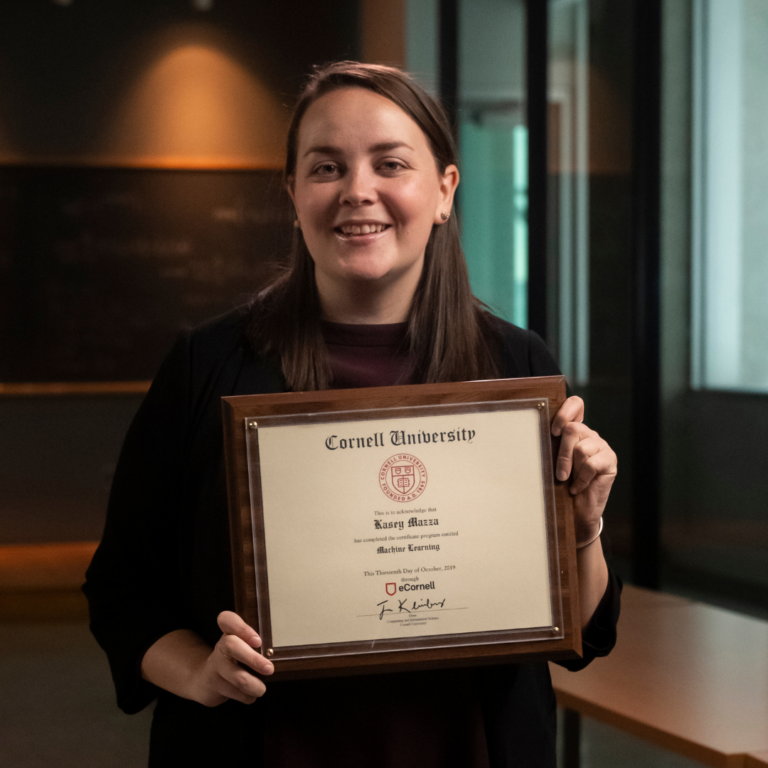
Completing a program from eCornell really has allowed me to think outside the box at work. It gave me the confidence I needed to take a seat at that table and say I am ready.
‐ Kasey M.
Kasey M.

Frequently Asked Questions

Technical teams move fast, and leadership gaps tend to show up in the moments that matter most: a tense cross-functional meeting, a decision that needs buy-in, feedback that lands poorly, or a conflict that quietly drains momentum. Cornell’s Technology Leadership Certificate is built for those real situations, helping you lead with more clarity, consistency, and confidence in the environments where technology professionals work.

In this certificate, authored by faculty from the Cornell Duffield College of Engineering, you will assess your leadership strengths and values, diagnose how you make decisions, and practice communication skills that support collaboration, feedback, and influence. The learning is designed to translate directly into how you run conversations, guide teams, and motivate behavior change, not just what you know.

You will also build practical, reusable tools you can bring back to work, including structured action plans, approaches for handling emotionally charged situations, and methods for shaping the environment so the right behaviors are easier to sustain.

If you want stronger day-to-day leadership habits, better communication in high-stakes moments, and a practical playbook for motivating and aligning technology teams, you should choose Cornell’s Technology Leadership Certificate.

Many online leadership programs rely on passive content and generic quizzes. Cornell’s Technology Leadership Certificate is different because you practice the behaviors that make technology leaders effective then refine them through structured discussion and project work that connects directly to your workplace.

The learning experience combines faculty-designed instruction with an expert facilitator who guides your cohort through applied exercises like interpreting assessment results, planning and running real conversations, and building action plans you can use immediately. Instead of treating communication and leadership as abstract ideas, the program has you rehearse concrete skills such as advanced listening, asking neutral and powerful questions, delivering specific feedback, and influencing behavior change by adjusting the environment.

The result is a human-centered, practice-forward experience that helps you turn leadership intent into repeatable habits inside real technology teams.

Plus, by enrolling in the Technology Leadership Certificate, you get two years of access to Leadership Symposium featuring two days of live, highly interactive virtual Zoom sessions that will explore today’s most pressing topics, giving you a unique opportunity to engage in real-time conversations with peers and experts from the Cornell community and beyond.

Enrolling in this certificate also provides you with a 6-month All-Access Pass to eCornell's live online AI Workshops, interactive sessions led by world-class Cornell faculty that combine Ivy League insight with practical applications for busy professionals. Each 3-hour Workshop features structured instruction, guided practice, and real tools to build competitive AI capabilities, plus the opportunity to connect with a global cohort of growth-oriented peers. While AI Workshops are not required, they enhance certificate programs through:

  • Integrating AI perspectives across most curricula
  • Responding to emerging AI developments and trends
  • Offering direct engagement with Cornell faculty at the forefront of AI research

Cornell’s Technology Leadership Certificate is designed for professionals who lead or influence technical work and want a practical way to strengthen the people side of leadership without stepping away from their role.

The Technology Leadership Certificate is a strong fit if you are:

  • An emerging or experienced technology leader who wants a more intentional leadership approach
  • A manager or director of software development, web services, or IT teams
  • An early- or mid-career technologist preparing to move into people leadership
  • A CTO or senior technical leader who needs repeatable tools for decision making, communication, and motivation
  • A business leader who partners closely with technology professionals and wants to lead technical stakeholders more effectively
  • A graduate student transitioning from an academic track to an industry track

Cornell’s Technology Leadership Certificate focuses on transferable leadership capabilities you can apply in product, engineering, IT, and cross-functional environments, regardless of your specific technology stack.

Project work in Cornell’s Technology Leadership Certificate is designed to help you apply leadership frameworks to real situations you are navigating, so you finish the program with practical artifacts and habits you can keep using.

Examples of projects past learners have completed include:

  • Building a repeatable communication system for high-stakes cross-functional meetings by combining Level 3 listening, powerful questions, “Yes, and…” phrasing, and lightweight decision and change logs to speed alignment and reduce rework.
  • Lowering conflict in a cross-team strategy engagement by reframing contentious concepts with clearer visuals and business-focused storytelling while rebuilding trust through targeted one-on-one conversations.
  • Raising productive tension to reduce an executive stakeholder’s overdependency by requiring proposed options with rationale before answering questions, cutting interruptions and strengthening independent decision making.
  • Expanding team resilience by influencing a strong individual contributor to involve peers early and run brief knowledge-transfer walkthroughs, reducing single-point-of-failure risk and improving support coverage.
  • Improving operational consistency on a production floor by creating structured time for end-of-shift reporting, adding visual reminders and accountability check-ins, and tracking accuracy and timeliness metrics week over week.

Across the Cornell’s Technology Leadership Certificate, you will typically build action plans, run structured reflection on real conversations and decisions, and refine your approach based on what happens when you apply the tools at work.

Cornell’s Technology Leadership Certificate helps you build the practical leadership behaviors that make you more effective at guiding technical work through people, decisions, and communication.

After completing Cornell’s Technology Leadership Certificate, you will have the skills to:

  • Manage tech teams * Motivate technology professionals to top performance
  • Increase effectiveness in leading projects with stakeholder buy-in
  • Apply your strengths and core values to increase team performance
  • Recognize factors that interfere with effective communication
  • Adapt advanced techniques for everyday interaction
  • Practice courageous communication and deliver persuasive messaging
  • Manage emotional reactions to common workplace issues
  • Positively reframe challenging workplace situations
  • Manage change by shaping environmental and situational factors

Students commonly describe long-term value that comes from pairing leadership frameworks with guided self-reflection and real workplace application. They report leaving with clearer approaches for navigating high-stakes conversations, strengthening team relationships, and making better decisions under pressure. Learners also highlight tools for courageous communication and effective feedback, strategies for handling conflict constructively, values-based practices that connect principles to daily choices, and insights into strengths that help them lead with greater intention. In survey feedback, students frequently mention that the lessons are easy to digest, the projects translate concepts into on-the-job habits, and facilitator feedback is thoughtful and actionable.

In addition, because eCornell represents the pinnacle of premium online professional education, participants in eCornell's programs often experience long-term career transformation such as promotions to more senior roles, salary increases, improved networking opportunities, and successful career transitions.

Cornell’s Technology Leadership Certificate, which consists of 6 short courses, is designed to be completed in 3 months. Each course in this certificate runs for 2 weeks, with a typical weekly time commitment of 3 to 5 hours for readings, short videos, discussions, and applied project work.

Most of the learning is asynchronous, so you can log in when it fits your schedule, as long as you meet course deadlines. To keep the experience interactive, the program also includes optional live sessions with your facilitator and peers. This structure gives you flexibility while still providing momentum and accountability as you build leadership habits.

Students in Cornell’s Technology Leadership Certificate often describe a learning experience that helps them lead more effectively in technical environments by pairing practical leadership frameworks with guided self-reflection and real workplace application. Many say they leave the program with clearer approaches for navigating high-stakes conversations, strengthening team relationships, and making better decisions as technology leaders.

Common themes students highlight include:

  • Practical frameworks for courageous communication and delivering effective feedback
  • Tools for handling conflict constructively and improving emotional awareness at work
  • Decision-making models they can use to evaluate options, involve others, and act with more clarity
  • Values-based leadership practices that connect personal principles to day-to-day leadership choices
  • Strengths and talent insights that help them lead with greater confidence and intention
  • Short, easy-to-digest lessons with strong real-world technology leadership relevance
  • Interactive projects and exercises that translate concepts into on-the-job habits
  • Highly engaged facilitators who provide thoughtful, actionable feedback
  • A well-structured course flow that builds skills module by module
  • Flexible pacing that fits demanding work schedules while still delivering depth and rigor

Across roles such as tech lead, engineer, and executive leader, students commonly report that they can apply what they learn immediately, whether that means improving feedback culture, running more effective conversations, coaching teammates, or making more consistent leadership decisions under pressure.

Cornell’s Technology Leadership Certificate welcomes both first-time and experienced leaders, including individual contributors who lead projects or influence decisions without formal authority. Success in the certificate depends more on your willingness to reflect and practice than on having a management title.

Because the curriculum focuses on leadership behaviors, no specific programming languages, tools, or advanced technical prerequisites are required. You will work with practical frameworks for strengths, values, decision making, communication, feedback, conflict, and influence, then apply them to real situations from your own workplace.

Learners tend to get the most value when they bring a current leadership challenge, such as improving feedback on a team, aligning stakeholders around a decision, or motivating behavior change in a fast-moving environment.

Technology leaders often default to technical problem solving when the real constraint is alignment, motivation, or communication. Cornell’s Technology Leadership Certificate gives you a set of concrete frameworks you can use to lead through those moments.

Tools and frameworks you will work with include:

  • CliftonStrengths (StrengthsFinder 2.0) language for identifying and communicating your top talent themes
  • A values discovery and alignment process that culminates in a personal values roadmap
  • The Vroom Decision Making for Leaders assessment, plus a decision-tree approach for choosing when to decide independently versus involve others
  • Listening levels (Levels 1 to 3), powerful questioning techniques, and collaborative phrasing such as replacing “but” with “Yes, and …”
  • Feedback and conflict tools, including the SBI model, Johari Window reflection, and strategies for raising or lowering the “heat” in a conflict
  • Influence and motivation methods such as push-versus-pull strategies; rational and emotional persuasion using logos, ethos, and pathos; and shaping environmental and situational factors to sustain behavior change

You will practice these tools through discussions and applied projects so they become usable habits, not just concepts.

Communication breakdowns in technical environments are rarely about intent. They are usually about timing, emotion, unclear expectations, and missed opportunities to involve the right people. Cornell’s Technology Leadership Certificate targets these issues directly by giving you repeatable ways to plan and run difficult conversations.

You will practice skills for:

  • Managing emotionally charged situations so the conversation stays productive
  • Giving and soliciting feedback using specific, actionable structures
  • Building a healthier feedback culture on your team through consistent norms
  • Turning conflict into better outcomes by calibrating intensity and surfacing the right issues at the right time
  • Increasing stakeholder buy-in by matching your decision-making approach to the situation and using influence strategies that fit the audience

By the end of Cornell’s Technology Leadership Certificate, you should be better equipped to lead conversations that improve relationships and results, even when the topic is high stakes.