Course list

Since the advent of the internet, programmers have been trying to figure out how to create a [digital] world in which people anywhere - even complete strangers - can transact directly with one another safely and efficiently. In essence, they have been trying to recreate the bedrock of civilization: an orderly system of bookkeeping that allows people to trust each other's claims about what they own, what they owe, and what they are owed. For most of the digital age, this “trust” has been facilitated by third parties such as banks, governments, or credible companies that are willing to guarantee that a transaction is valid and secure. But transactions via third parties are slow and expensive, and they cannot be verified by just anyone, which opens the door to fraud and theft.

Today, the notion of a secure and trusted third party in a digital world isn't purely mythical. And in fact, it's exactly what blockchain technology embodies in a kind of magical way. In this course, you will explore the mechanics of blockchain technology and how the blockchain acts like a trusted third party. To do this, Professor Ari Juels will design a theoretical cryptocurrency from scratch to illustrate how Bitcoin and other cryptocurrencies make use of the blockchain to transfer value from person to person. Then, once you understand how the blockchain acts as a trusted ledger, you will practice articulating other transformative ways in which blockchains can change how commercial and interpersonal connections happen online.

  • Jun 3, 2026
  • Jul 15, 2026
  • Aug 26, 2026
  • Oct 7, 2026
  • Nov 18, 2026
  • Dec 30, 2026
  • Feb 10, 2027

Cryptography has been around for thousands of years and is at the heart of digital communications today. Most people rely on cryptography on a daily basis without even knowing it; most popular messaging apps use encryption to ensure the security of messaging between two people. Blockchain technology, in a similar way, relies on cryptography to protect the identity of those sending and receiving messages and ensures that all information and transactions are secure and legitimate. Thus, to really understand blockchain technology, you have to understand the core principles of cryptography.

This course will walk you through the basics of cryptography: how information has historically been disguised (encrypted) and revealed (decrypted) using mathematics. You will see how a message can be turned into a number, and how that number can be encrypted and decrypted by two complete strangers. You will practice encrypting your own message to understand the basics of what makes a good encryption scheme. Then, you will delve deeper into the specific type of cryptography used in blockchain technology -- public key cryptography - and the promises and limitations it has in carrying out the core functions of a blockchain. You will create your own theoretical gold exchange in order to more fully understand how you can send anything to anyone around the world without a middleman. Ultimately you will know exactly how information on the blockchain is secured, legitimized, and authenticated without needing a third party to verify it.

You are required to have completed the following course or have equivalent experience before taking this course:

  • Cryptocurrencies and Ledgers
  • May 6, 2026
  • Jun 17, 2026
  • Jul 29, 2026
  • Sep 9, 2026
  • Oct 21, 2026
  • Dec 2, 2026
  • Jan 13, 2027

Variations of blockchain technology have existed for decades, but the recent hype is the result of a new kind of blockchain, one that distributes the responsibility of verifying transactions and thereby making it more secure, transparent, and enduring. This course will teach you to understand the differences between the blockchain technology of today and the former, less accessible and less transparent blockchains of decades past. You will dig into the mechanics of the [newer] Bitcoin blockchain protocol and how it ensures the longevity of a decentralized public ledger as well as how it gets consensus for approving transactions. With that knowledge you will then work to analyze what problem(s) blockchain technology aims to solve, how it solves them, and how to make sense of the promises that developers of new blockchain protocols make.

You will analyze a sample protocol to determine why the protocol might not satisfy the key properties that make a “good” blockchain secure. You will be better prepared to critically analyze all the endless new cryptocurrencies that emerge and the underlying blockchain technology that they operate on. You will outline several industries and business purposes for which the blockchains of today make sense. You will solve a computational puzzle in Excel to better understand how transactions get verified in the Bitcoin blockchain protocol. In the course project, you will design a theoretical blockchain for a company, outlining advantages and disadvantages of the properties you will think the blockchain should have based on the unique aspects of your business.

You are required to have completed the following course or have equivalent experience before taking this course:

  • Cryptocurrencies and Ledgers
  • Cryptography Essentials
  • May 20, 2026
  • Jul 1, 2026
  • Aug 12, 2026
  • Sep 23, 2026
  • Nov 4, 2026
  • Dec 16, 2026
  • Jan 27, 2027

Blockchain has recently become synonymous with “cryptocurrency,” but its applications are much wider than financial transactions. Though cryptocurrencies constitute the most popular of applications, the business applications are endless. In fact, any industry that makes use of an intermediary to verify transactions could in theory make use of blockchain technology. But how do people know if their industry and/or company stands to gain from adopting the technology?

This course provides you with the tools to discern the applicability of blockchain technology to your business model. You will do this by learning about smart contracts and how you can implement minimal trust applications for almost any task imaginable. You will analyze how smart contracts work, how they're used today, and how to reason about their capabilities, and what ongoing technical challenges they pose. In the course project, you will come up with your own smart contract application and outline the challenges that might exist in its adoption. Ultimately you will walk away with the ability to answer one important question: Does your business need a blockchain?

You are required to have completed the following course or have equivalent experience before taking this course:

  • Cryptocurrencies and Ledgers
  • Cryptography Essentials
  • Blockchain Fundamentals
  • Apr 22, 2026
  • Jun 3, 2026
  • Jul 15, 2026
  • Aug 26, 2026
  • Oct 7, 2026
  • Nov 18, 2026
  • Dec 30, 2026

eCornell Online Workshops are live, interactive 3-hour learning experiences led by Cornell faculty experts. These premium short-format sessions focus on AI topics and are designed for busy professionals who want to gain immediately applicable skills and strategic perspectives. Workshops include faculty presentations, breakout discussions, and guided hands-on practice.

The AI Workshops All-Access Pass provides you with unlimited participation for 6 months from your date of purchase. Whether you choose to attend one workshop per month, or several per week, the All-Access Pass will allow you to customize your AI journey and stay on top of the latest AI trends.

Workshops cover a range of cutting-edge AI topics applicable across industries, hosted by Cornell faculty at the forefront of their fields. Whether you are just getting started with AI, seeking to build your AI skillset, or exploring advanced applications of AI, Workshops will provide you with an action-oriented learning experience for immediate application in your career. Sample Workshops include:

  • Work Smarter with AI Agents: Individual and Team Effectiveness
  • Leading AI Transformation: Bigger Than You Imagine, Harder Than You Expect
  • Using AI at Work: Practical Choices and Better Results
  • Search & Discoverability in the Era of AI
  • Don't Just Prompt AI - Govern it
  • AI-Powered Product Manager
  • Leverage AI and Human Connection to Lead through Uncertainty

Request
more Info
by completing the form below.

Act today—courses are filling fast.

How It Works

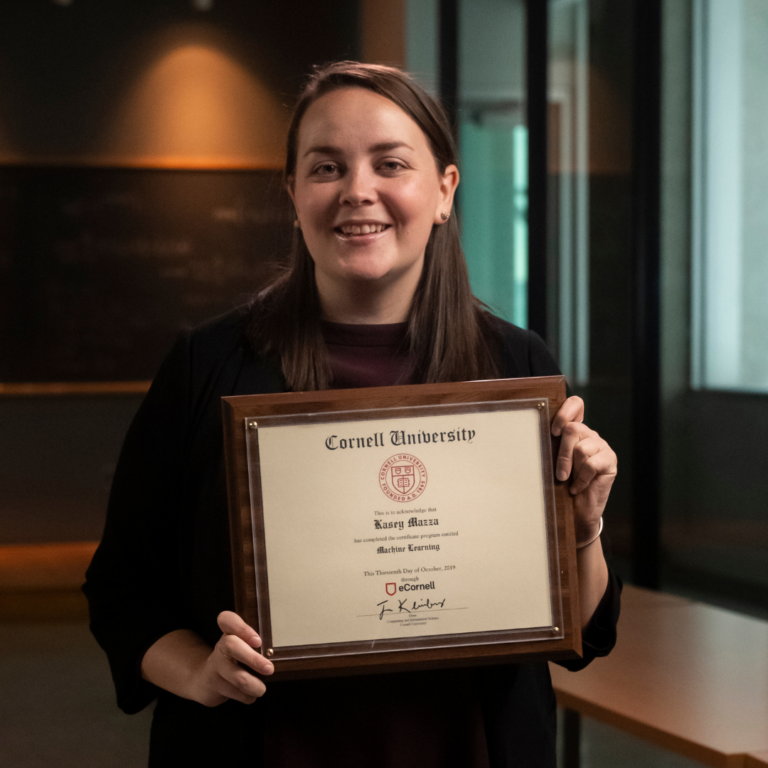
Completing a program from eCornell really has allowed me to think outside the box at work. It gave me the confidence I needed to take a seat at that table and say I am ready.
‐ Kasey M.
Kasey M.

Frequently Asked Questions

Blockchain is showing up everywhere from payments and digital assets to supply chain claims and automated agreements, but it can be hard to separate what is technically real from what is just hype. Cornell’s Blockchain Essentials Certificate helps you build a clear, practical understanding of how blockchains create trust, how cryptocurrencies like Bitcoin actually work, and where blockchain solutions make sense in business.

In this certificate program, authored by faculty from Cornell Tech, you will learn how digital ledgers record ownership and prevent double-spending, how public-key cryptography and digital signatures secure transactions, and how different blockchain models and consensus approaches affect speed, security, and governance. You’ll also explore smart contracts and the real constraints that shape adoption, including correctness, confidentiality, oracle design, and misuse risks.

If you want a clear foundation in how blockchain works, a framework for evaluating real business use cases, and the ability to propose a responsible blockchain application for your organization, you should choose Cornell’s Blockchain Essentials Certificate.

Many online blockchain courses focus on headlines or vocabulary. Cornell’s Blockchain Essentials Certificate is built to help you reason from first principles so you can evaluate claims, risks, and opportunities with confidence.

You learn in a small, facilitated cohort with structured discussions, graded project work, and feedback that helps you apply concepts instead of just watching videos. The curriculum is designed by Cornell Tech faculty who research blockchains, cryptography, and security, and the learning experience emphasizes practical application such as analyzing how ledgers achieve trust, how digital signatures authorize transactions, how consensus mechanisms work, and where smart contracts create value or introduce risk.

By the end of Cornell’s Blockchain Essentials Certificate, you will be equipped not only to explain what a blockchain is, but also to assess whether a proposed blockchain solution fits your organization’s needs and constraints.

Enrolling in this certificate also provides you with a 6-month All-Access Pass to eCornell's live online AI Workshops, interactive sessions led by world-class Cornell faculty that combine Ivy League insight with practical applications for busy professionals. Each 3-hour Workshop features structured instruction, guided practice, and real tools to build competitive AI capabilities, plus the opportunity to connect with a global cohort of growth-oriented peers. While AI Workshops are not required, they enhance certificate programs through:

  • Integrating AI perspectives across most curricula
  • Responding to emerging AI developments and trends
  • Offering direct engagement with Cornell faculty at the forefront of AI research

Cornell’s Blockchain Essentials Certificate is designed for professionals who want to understand blockchain technology clearly enough to discuss it credibly, evaluate it responsibly, and apply it thoughtfully.

The Blockchain Essentials Certificate is a strong fit if you are:

  • A business leader or entrepreneur assessing blockchain initiatives, vendors, or new product opportunities
  • A technology leader, including a CTO, who needs a shared language for blockchain, cryptography, and smart contracts
  • A developer or software engineer who wants stronger fundamentals in ledgers, signatures, consensus, and smart contract trade-offs
  • A professional in any industry who wants to move beyond the headlines and understand what blockchains can and cannot do

Because Cornell’s Blockchain Essentials Certificate includes conceptual analysis and applied projects, you will get the most value if you are ready to engage with technical ideas at a practical level, even if you are not planning to write code.

Across Cornell’s Blockchain Essentials Certificate, you build hands-on skill by producing short, structured deliverables that mirror the kinds of analysis and decision making you would do on a real team evaluating blockchain.

In the Blockchain Essentials Certificate, project work includes:

  • Critiquing a mock cryptocurrency design and identifying what it gets right and wrong about trust, ownership, and transfer
  • Installing and using a mobile cryptocurrency wallet to understand addresses, keys, and the mechanics of real transactions
  • Proposing a blockchain application by linking a business problem to specific blockchain properties such as indelible records and strict ordering
  • Analyzing an encryption scheme and evaluating how key management affects real-world security
  • Examining how key pairs and digital signatures underpin everyday tools and blockchain transactions
  • Designing a theoretical commodity exchange that uses a public ledger and signed transactions to transfer assets without an intermediary
  • Evaluating a sample blockchain protocol for core security properties such as consistency and liveness
  • Completing an Excel-based computational puzzle to experience the basic mechanics behind Proof of Work
  • Recommending an appropriate blockchain approach for a business need by weighing permissioned and permissionless trade-offs
  • Specifying the step-by-step logic for a fair lottery and translating that logic into a smart-contract style design
  • Proposing a smart contract application, then hardening it by addressing correctness, confidentiality, oracle needs, and misuse risks

Cornell’s Blockchain Essentials Certificate helps you build the technical fluency and business judgment to participate more credibly in blockchain-related decisions, whether you are evaluating a new product, advising stakeholders, or assessing risk.

After completing the Blockchain Essentials Certificate, you will have the skills to:

  • Understand the mechanics of blockchain technology
  • Understand applications and implications of blockchain for your business
  • Identify key problems blockchain technology solves and how it solves them
  • Discover the cryptographic underpinnings of blockchains
  • Articulate the capabilities and practical application of blockchains/digital ledgers
  • Propose how digital signatures can be used in business applications
  • Determine how blockchain technologies can support your business goals

Students commonly describe the experience as making a complex, fast-moving topic feel clear, practical, and immediately useful. They often report leaving with a confident grasp of core concepts like wallets, transactions, and trust mechanisms, a clearer understanding of cryptography fundamentals such as public and private keys and digital signatures, and more practical insight into smart contracts and different blockchain models. Many also emphasize that the step-by-step course flow and applied activities helped them connect blockchain concepts to real work in areas like finance, auditing, and emerging initiatives.

What truly sets eCornell apart is how our programs unlock genuine career transformation. Learners earn promotions to senior positions, enjoy meaningful salary growth, build valuable professional networks, and navigate successful career transitions.

Cornell’s Blockchain Essentials Certificate, which consists of 4 short courses, is designed to be completed in 2 months. Each course runs for 2 weeks, with a typical weekly time commitment of 3 to 5 hours.

The schedule is designed to be realistic alongside a full-time job, with weekly deadlines that keep you moving while letting you choose when to do the work. You can complete most activities asynchronously, and you have opportunities to join live online sessions that reinforce key concepts and let you learn with your cohort in real time.

Students in Cornell’s Blockchain Essentials Certificate often say the program makes a complex, fast-moving topic feel clear, practical, and immediately useful, especially for professionals who want to understand how blockchain works beyond the headlines and how it connects to cryptocurrency and real business use cases. Many describe leaving with a confident grasp of core concepts and a framework they can apply on the job or use as a springboard for deeper exploration.

Students frequently highlight:

  • Clear explanations of blockchain, bitcoin, and distributed ledgers that reduce the intimidation factor
  • Strong coverage of key building blocks like wallets, transactions, and trust mechanisms in networks
  • Practical understanding of smart contracts and where they fit in real systems
  • Demystifying cryptography fundamentals, including public and private keys, digital signatures, and secure data exchange
  • Insight into different blockchain models and consensus approaches (such as permissioned vs. permissionless networks)
  • Real-world context that helps connect the technology to current projects, auditing, finance, and emerging initiatives

Beyond the subject matter, students also value the learning experience itself, noting the Blockchain Essentials Certificate program’s approachable structure and supportive environment:

  • Short, focused lessons that are easy to fit into a busy schedule
  • A well-organized course flow that builds concepts step by step
  • Engaging video instruction with helpful visuals and examples
  • Activities and projects that reinforce learning through application
  • Responsive facilitator feedback that keep learners moving forward

A programming background is not required to gain value from Cornell’s Blockchain Essentials Certificate. You spend most of your time learning the concepts that make blockchains trustworthy and useful, then applying those concepts through analysis and design focused assignments.

You will work with practical artifacts such as a mobile crypto wallet and an Excel-based exercise that simulates key ideas behind transaction verification. You’ll also examine real smart contract examples, and you have the option to look at smart contract code in a development environment, but the program emphasizes understanding capabilities, limitations, and risk trade-offs rather than training you to become a smart contract developer.

Smart contracts are a central part of Cornell’s Blockchain Essentials Certificate because they show how blockchains can do more than record transactions. You will learn how smart contracts function as programs on a blockchain, what it means for execution to be immutable, transparent, and strictly ordered, and how platforms like Ethereum use concepts such as gas to manage computation.

You will also learn how to evaluate when a smart contract is the right tool by rewriting a proposed use case as a step-by-step process a trusted third party could perform, then deciding whether blockchain guarantees are worth the cost and constraints. Just as important, you explore real adoption challenges, including bugs in immutable code, confidentiality limits of public state, and reliance on external data sources called oracles.

You will learn a repeatable way to evaluate blockchain proposals by linking a business problem to the specific properties a blockchain can provide, then weighing the costs and risks that come with those properties. Cornell’s Blockchain Essentials Certificate helps you move from general enthusiasm to a defensible recommendation.

During the program, you examine the core properties that make blockchains distinctive, explore the trade-offs between permissioned and permissionless designs, and study how consensus mechanisms such as Proof of Work affect speed, finality, and operational cost. You also apply smart contract reasoning tools and decision frameworks that help you identify when a conventional database or trusted intermediary is the better choice.

By the end of Cornell’s Blockchain Essentials Certificate program, you will be able to propose a blockchain or smart contract concept and stress test it against real constraints like confidentiality needs, correctness risks, and reliance on external data.